
If you drive for work, you have probably wondered: can you write off gas for work on your tax return? The short answer is yes, but only if you are self-employed or an independent contractor. The IRS gives you two ways to deduct vehicle costs, and picking the right one could save you hundreds or even thousands of dollars.
This guide breaks down exactly who qualifies, how the gas tax deduction for self-employed workers operates, and whether tracking fuel expenses for a deduction or logging miles gets you a bigger write-off.
Can You Write Off Gas as a Business Expense?
Yes, you can deduct gas for business driving, but not as a standalone expense. The IRS bundles gas into two deduction methods: the standard mileage rate and the actual expense method.
With the standard mileage rate, gas is already included in the per-mile rate. You cannot deduct gas separately on top of it. With the actual expense method, you deduct real gas costs alongside insurance, repairs, depreciation, and other vehicle expenses.
There is one important exception. Commuting between your home and your regular workplace is never deductible, regardless of which method you use. Only driving between work locations, to client sites, or for business errands counts.
Standard Mileage Rate vs Actual Gas Expenses
This is the most critical decision you will make regarding your vehicle deduction. The two methods work very differently, and the best choice depends on your situation.
Standard Mileage Rate
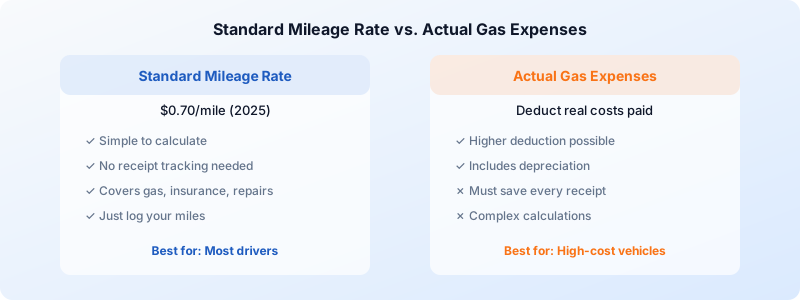
The IRS sets a flat rate per business mile driven. For 2025, that rate is $0.70 per mile. Check the 2026 IRS mileage rate for the latest figure. You multiply your total business miles by the rate, and that is your deduction.
For example, if you drove 12,000 business miles in 2025, your deduction would be $8,400 (12,000 x $0.70). This rate covers gas, oil, insurance, registration, repairs, and depreciation all in one number.
Actual Expense Method
With this method, you track and deduct every real cost of operating your vehicle. That includes gas, oil changes, tires, insurance premiums, lease payments, parking, tolls, and depreciation.
You then calculate your business-use percentage by dividing business miles by total miles driven. If you drove 20,000 total miles and 12,000 were for business, your business-use percentage is 60%. You deduct 60% of all vehicle expenses.
For a detailed breakdown of both approaches, read our guide on standard mileage vs actual expenses.
Who Qualifies to Deduct Gas or Mileage?
Not everyone can deduct gas for business driving. Your eligibility depends on your employment status.
You Qualify If You Are:
- Self-employed (sole proprietors, freelancers, independent contractors)
- Gig workers (rideshare drivers, delivery drivers, couriers)
- Small business owners using a personal vehicle for business
- Armed Forces reservists traveling to reserve duties
- Certain state or local government officials paid on a fee basis
You Do NOT Qualify If You Are:
- A W-2 employee (even if your employer does not reimburse you)
- Driving for your daily commute to a fixed workplace
- Using a company-owned vehicle (the business deducts it instead)
The Tax Cuts and Jobs Act suspended unreimbursed employee expense deductions for W-2 workers through at least 2025. If you are an employee, your only option is to ask your employer for a mileage reimbursement.
Learn exactly how to file your deduction in our step-by-step guide on how to claim mileage on taxes as a self-employed worker.
How to Track Gas Expenses for Taxes
The IRS requires documentation for every deduction you claim. Sloppy records are the fastest way to lose a deduction in an audit. Here is what you need for each method.
For the Standard Mileage Rate
You need a mileage log that records:
- Date of each trip
- Starting and ending locations
- Business purpose (client meeting, supply pickup, job site visit)
- Miles driven for each trip
You do not need gas receipts with this method. But your mileage log must be contemporaneous, meaning you record trips at or near the time they happen, not from memory at year-end.
For the Actual Expense Method
On top of a mileage log (to calculate business-use percentage), you also need:
- Gas receipts with dates and amounts
- Repair and maintenance invoices
- Insurance premium statements
- Registration and licensing fees
- Lease or loan payment records
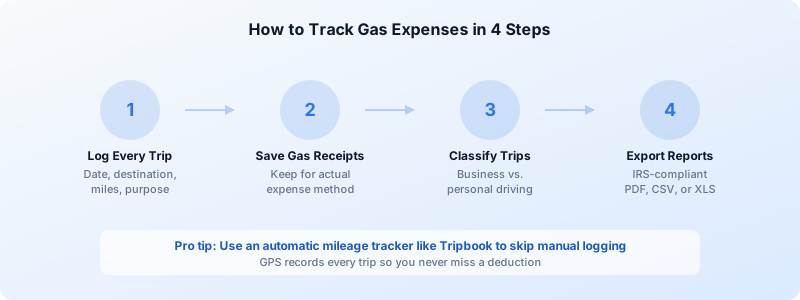
Manually tracking all of this is tedious. Apps like Tripbook use GPS to automatically log every trip with the date, route, and distance. You just swipe to classify each trip as business or personal, and the app generates IRS-compliant reports you can hand directly to your accountant.
Which Method Saves You More Money?
The gas vs mileage deduction question comes down to your specific numbers. Neither method is universally better.
Choose the Standard Mileage Rate If:
- You drive a fuel-efficient or low-cost vehicle
- You do not want to track individual receipts
- Your annual vehicle expenses are below average
- You want the simplest tax filing process
Choose the Actual Expense Method If:
- You drive an expensive vehicle with high depreciation
- Your gas costs are unusually high (heavy trucks, long distances)
- You pay steep insurance premiums or lease payments
- Your vehicle expenses exceed what the mileage rate would give you
Run the Numbers: A Quick Example
Say you drove 15,000 business miles last year. Your total vehicle expenses (gas, insurance, repairs, depreciation) came to $12,500. Your business-use percentage is 75%.
- Standard mileage rate: 15,000 x $0.70 = $10,500
- Actual expense method: $12,500 x 75% = $9,375
In this scenario, the standard mileage rate wins by $1,125. But if your total vehicle costs were $16,000 instead, actual expenses would yield $12,000, beating the mileage rate by $1,500.
The only way to know for sure is to calculate both methods with your real numbers. Many tax professionals recommend running the comparison each year because your costs and driving patterns change.
First-Year Rule
If you want to use the standard mileage rate, you must choose it in the first year you use the vehicle for business. You can switch to the actual expense method in later years. But if you start with actual expenses, you are locked out of the standard mileage rate for that vehicle permanently.
Start Tracking Your Miles Today
Whether you plan to deduct gas for business or use the standard mileage rate, accurate trip records are non-negotiable. The IRS can disallow your entire deduction if your documentation falls short.
The easiest way to stay audit-ready is to automate your tracking. Download Tripbook and let the app record every business mile in the background. Classify trips with a swipe, export tax-compliant reports in PDF or CSV, and stop worrying about whether you can write off gas for work. Your records will speak for themselves.