Mileage tracking with multiple jobs is one of the more confusing areas of tax deductions. You might drive to a W-2 job in the morning, then head to a 1099 side hustle in the evening, then back home — and the deductibility rules for each leg of that trip are completely different. Get them wrong and you either miss legitimate deductions or claim miles you cannot actually write off.
This guide breaks it down clearly so you can track confidently and report correctly.
The Challenge of Multiple Jobs
According to the Bureau of Labor Statistics, about 8% of American workers hold more than one job. Many of these workers drive between their different work locations, to client sites, and around town for various income-generating activities — without any clear framework for which miles count.
The core problem is that two different tax rules govern your two jobs. Your W-2 employment income is subject to one set of rules. Your self-employed or 1099 income is subject to another. And the miles you drive can sometimes belong to both worlds, depending on when and where you drive.
W-2 vs. 1099: Two Different Deduction Worlds
The single most important thing to understand about mileage tracking with multiple jobs is the impact of the Tax Cuts and Jobs Act of 2018.
Before 2018, W-2 employees could deduct unreimbursed business mileage as a miscellaneous itemized deduction. The TCJA eliminated that. As of 2026, W-2 employees cannot deduct unreimbursed mileage on their federal return — regardless of how many miles they drive for their employer and regardless of whether their employer reimburses them.
1099 contractors and self-employed workers operate under a completely different set of rules. Every qualifying business mile you drive for your self-employed income is fully deductible on Schedule C at the IRS standard mileage rate — 72.5 cents per mile in 2026.
So if you have both a W-2 job and a 1099 side hustle:
- Miles driven for your W-2 employer: no federal deduction
- Miles driven for your 1099 work: fully deductible on Schedule C
The Most Valuable Rule: Mileage Between Two Jobs on the Same Day
Here is a specific IRS rule that many multi-job workers do not know about, and it can save you meaningful money.
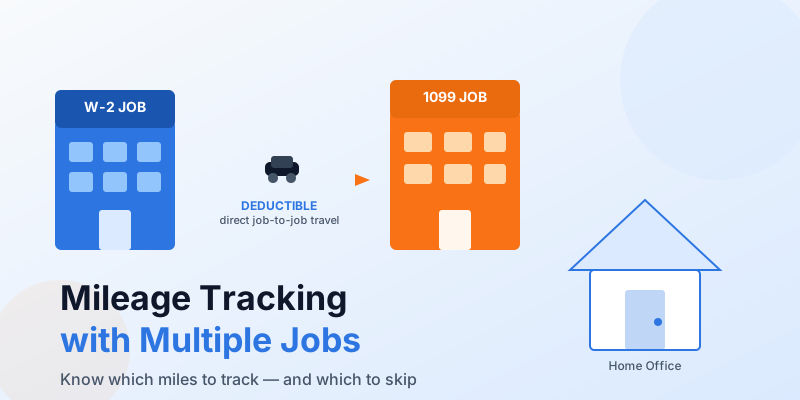
If you travel directly from one job to a second job on the same day, those miles are deductible business miles — even if one of the jobs is a W-2 position.
The IRS classifies this type of travel as business transportation, not commuting. The reasoning is that you are not going home; you are traveling between two income-producing locations.
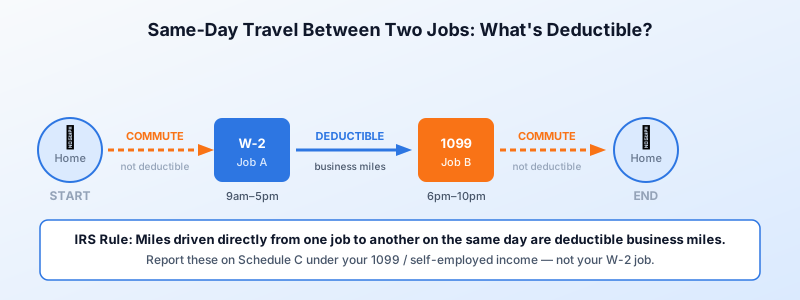
A concrete example: you work 9am to 5pm as a full-time office employee (W-2), then drive directly to your 1099 freelance photography client at 6pm. The miles from your W-2 office to the photography client’s location are deductible on Schedule C.
What is not deductible:
- Your drive from home to your W-2 office (regular commute)
- Your drive home from your last job of the day (return commute)
The more jobs or gig platforms you work across in a day, the more opportunities you have to capture legitimate between-job miles.
Traveling to Temporary Work Locations
Another rule that helps multi-job workers: the temporary work location exception.
If your regular W-2 job has a fixed office, but occasionally sends you to a client site or different location for the day, those miles — from your regular office to the temporary location and back — are deductible.
For your 1099 work, any travel from your home directly to a client’s location is also deductible. When you are self-employed and your home serves as your primary business location, there is no commute to worry about — all client-site travel counts as business mileage.
For a full breakdown of what qualifies as a business mile, see our guide to business miles vs. commuting miles.
Home Office and the Multiple-Job Driver
If you run a legitimate home office for your 1099 work — a dedicated space used regularly and exclusively for your self-employment — then your home becomes your principal place of business for that work. This changes the math on many of your trips.
When your home is your principal place of business, trips from home to client meetings, supply stores, or other business locations for your self-employed work are fully deductible. This matters especially for gig workers, freelancers, and side-hustle operators who take a lot of short trips from home throughout the week.
Read more in our self-employed tax deductions guide for the full picture on home office and related deductions.
Keeping Separate Logs (or One Smart Log)
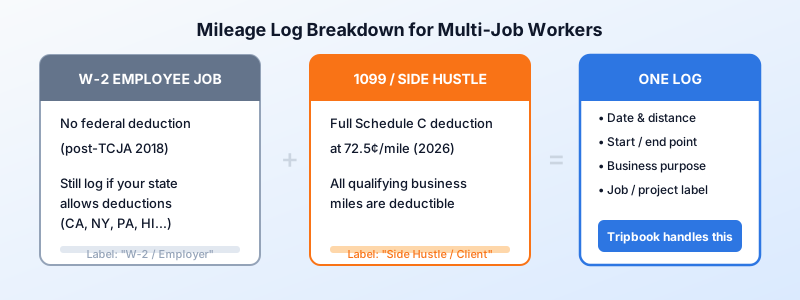
The IRS requires you to keep records that identify each trip’s date, starting point, destination, mileage, and business purpose. When you have multiple jobs, you also need to know which job each trip belongs to — because W-2 mileage and 1099 mileage go in different places (or nowhere, in the case of W-2 federal returns).
You have two options:
1. Keep separate logs. One for your W-2 employer (for state deduction purposes or reimbursement requests), and one for your self-employment work. This is clean but requires discipline.
2. Use one app with trip labels. This is the more practical approach for most people. Apps like Tripbook let you label each trip by job, client, or project. At year-end, you filter by your 1099 work and pull your Schedule C total. Your W-2 trips are there too if you ever need them for a state return or reimbursement claim.
Real-World Examples
Full-time office worker + weekend Uber driver: Your commute to the office is not deductible. But every mile you put on your car while driving for Uber is deductible on Schedule C. If you go from your office straight to a pickup after work, those miles from office to first rider also count.
Hospital nurse (W-2) + home health 1099 contractor: Your drive from home to the hospital is a commute — not deductible. But if after your hospital shift you drive directly to a home health patient’s house for your 1099 work, the miles from the hospital to the patient’s home are deductible business miles. Learn more about tracking in the mileage tracking for nurses and healthcare workers guide.
Office employee + real estate agent (1099): All of your real estate-related driving — open houses, client showings, the MLS office, continuing education — is fully deductible on Schedule C. Your commute to your primary office is not.
Start Tracking Every Job Separately
Mileage tracking with multiple jobs does not have to be complicated. The key is to capture every trip and label it by income source. When you do that consistently, you can pull exactly what your accountant needs at tax time without guessing.
Tripbook makes this automatic. It runs in the background on your iPhone, logs your drives as they happen, and lets you assign each trip to a job or client with one tap. No spreadsheets, no end-of-year scramble.
Download Tripbook on the App Store and start logging both jobs from your very next drive.