
Amazon Flex drivers put serious miles on their cars. Amazon pays you per block, but it does not track your mileage or send you any tax documentation for your vehicle expenses. That’s your job — and getting it right can be worth thousands of dollars.
At the 2026 IRS standard mileage rate of 72.5 cents per mile, a typical Flex driver who puts in 20,000 delivery miles a year has a $14,500 tax deduction sitting in their odometer. Here’s how to capture it.
Why Amazon Flex Mileage Tracking Matters
Amazon Flex drivers are independent contractors, not employees. You receive a 1099-NEC at tax time showing your gross earnings. From that gross income, you can deduct your ordinary and necessary business expenses — and vehicle mileage is almost always the largest deduction available.
The IRS does not automatically apply any deduction. If you don’t track and report your miles, you pay taxes on income you spent on gas and vehicle wear. Most Flex drivers are already in a tax-disadvantaged position because self-employment income is subject to self-employment tax of 15.3% on top of income tax. Every legitimate deduction reduces both.
The numbers: At 72.5¢/mile, every 1,000 miles you log = $725 in deductions. If you're in the 22% bracket plus self-employment tax, that's roughly $270 less in taxes per 1,000 miles tracked.
Which Miles Are Deductible for Amazon Flex Drivers
Not every mile you drive on a delivery day is deductible. The IRS has specific rules about what counts as business mileage.
Deductible miles:
- Miles from your first pickup location (Amazon delivery station or Whole Foods store) to your first delivery stop
- Miles between delivery stops on the same block
- Miles from your last delivery stop to return to the station (if required)
- Miles driven to pick up packages at any location
Not deductible:
- The drive from your home to the first delivery station — this is a commute, and commuting miles are never deductible under IRS rules
- Personal errands you run during or after a delivery block
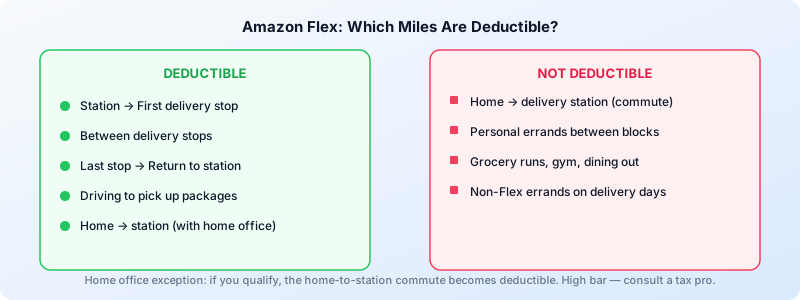
The home office exception: If you qualify for a legitimate home office deduction — meaning you use a portion of your home exclusively and regularly as your principal place of business — your first drive from home to the pickup location can become deductible. This is a high bar to meet, and it requires using dedicated space exclusively for business. Talk to a tax professional before claiming this.
How Much Can You Save?
The average Amazon Flex driver completes 15,000 to 25,000 delivery miles per year, though heavy drivers in dense urban markets can exceed that.
Here’s what those miles translate to at the 2026 rate:
| Annual Delivery Miles | Deduction at 72.5¢/mile |
|---|---|
| 10,000 miles | $7,250 |
| 15,000 miles | $10,875 |
| 20,000 miles | $14,500 |
| 25,000 miles | $18,125 |
These are deductions from your gross income — they reduce the amount of income you pay both income tax and self-employment tax on. For a driver in the 22% federal bracket, a $14,500 deduction reduces their tax bill by roughly $5,300.
Amazon Flex and the 1099-NEC
In January, Amazon sends you a 1099-NEC (Non-Employee Compensation) form showing your total earnings for the year. This is your gross income before any expenses. You report this on Schedule C (Profit or Loss from Business) when you file your taxes.
On Schedule C, you list your gross revenue and then deduct your business expenses — including your vehicle mileage. Your net profit from Schedule C flows to your Form 1040 and is subject to self-employment tax.
If you earned $30,000 from Flex and have $14,500 in mileage deductions plus other expenses, your taxable business income could be substantially lower. The difference between tracking your miles and not tracking them can easily be thousands of dollars.
For a full overview of what else you can deduct as a delivery driver, see our delivery driver tax deductions guide.
Standard Mileage Rate vs. Actual Expenses
You have two ways to deduct your vehicle costs:
Standard mileage rate (72.5¢/mile): Multiply your business miles by the IRS rate. This covers gas, depreciation, maintenance, and wear — everything bundled into one number. Simple, and requires only a mileage log.
Actual expenses method: Track every dollar you spend on gas, oil, tires, insurance, registration, and repairs. Multiply those total costs by your business-use percentage. Requires much more record-keeping and often produces a similar or smaller deduction than the standard rate for most Flex drivers.
Key rule: If you use the standard mileage rate in the first year you use a vehicle for business, you can switch to actual expenses in a later year. But if you start with actual expenses in year one, you can never use the standard mileage rate for that vehicle. The standard mileage method is almost always the right choice for flexibility.
For most Flex drivers, the standard mileage rate is simpler and produces a competitive deduction without requiring you to save every gas receipt. See our comparison of standard mileage vs. actual expenses if you want to run the numbers for your situation.
How to Track Your Amazon Flex Miles Automatically
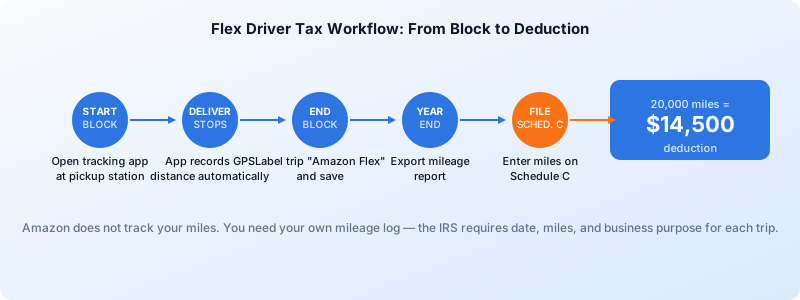
Amazon does not log your mileage. The app records your blocks and deliveries, but it does not output an IRS-compliant mileage record. You need your own system.
Manual tracking (writing down odometer readings) works, but it’s easy to forget — especially when you’re rushing between stops. The better approach is to use an automatic mileage tracking app that detects when you’re driving and records your trips in the background.
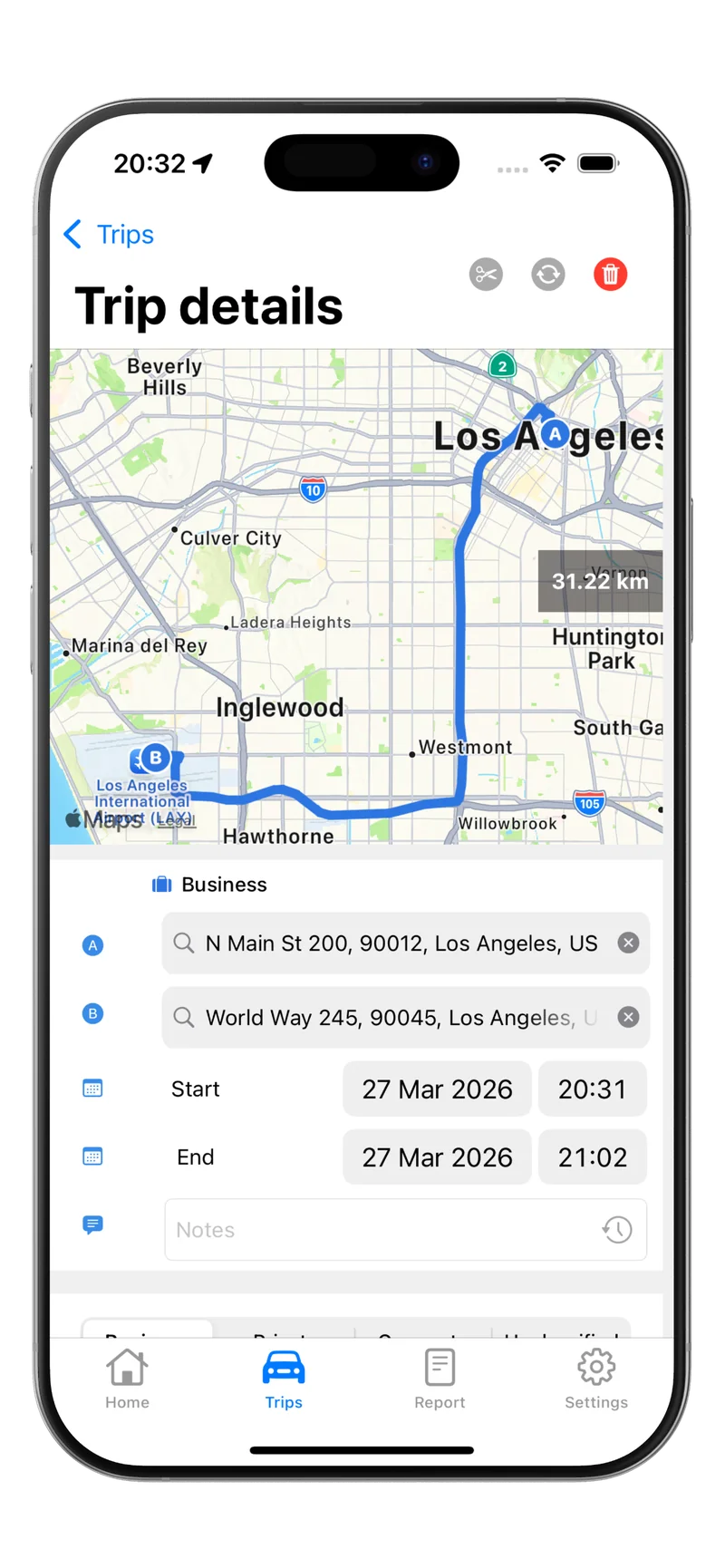
With Tripbook, you start a trip at the beginning of each delivery block and the app tracks distance automatically using your iPhone’s GPS. You can label each trip as “Amazon Flex” and add notes about the pickup location. At tax time, you export a mileage report that shows every trip, total miles, and the total deduction value at the current IRS rate.
For a deeper look at mileage log requirements and what the IRS expects, read our guide on IRS mileage log requirements. If you’ve gone weeks without logging, don’t panic — our guide on reconstructing missed mileage walks through your options.
What to Do at Tax Time
When you sit down to file:
- Pull your mileage report from your tracking app for the year
- Separate delivery miles from personal miles
- Enter total business miles on Schedule C, Part II, Line 9 (Car and Truck Expenses), and complete Form 4562 or the mileage section of Schedule C
- Keep your mileage log on file for at least 3 years — that’s the standard IRS audit window, though it extends to 6 years for substantial underreporting
You don’t submit your mileage log with your return, but you need it available if the IRS asks. A digital log from a mileage app is as valid as a paper logbook.
The Bottom Line
Amazon Flex mileage tracking is one of the highest-value tax moves available to delivery drivers. The math is simple: at 72.5 cents per mile, every 10,000 miles you track and report is a $7,250 deduction. The only requirement is keeping an accurate log.
Amazon won’t do this for you. Your mileage log is your responsibility — and your opportunity.
Download Tripbook and start tracking every Amazon Flex mile from your next delivery block.