
If you drive between two jobs during the same day, you might assume those miles are deductible. Historically, that was true for almost everyone. But tax law has shifted dramatically, and the rules around mileage between two jobs now depend entirely on how you earn your income.
This guide breaks down what the IRS considers deductible travel between workplaces, who qualifies for the deduction in 2026, and what W-2 employees need to know after the permanent changes introduced by the One Big Beautiful Bill Act (OBBBA).
How the IRS defines mileage between two jobs
The IRS has always drawn a clear line between commuting miles and business miles. Your commute, the drive from home to your regular workplace and back, is a personal expense. It is never deductible regardless of how far you drive or what you do during the trip.
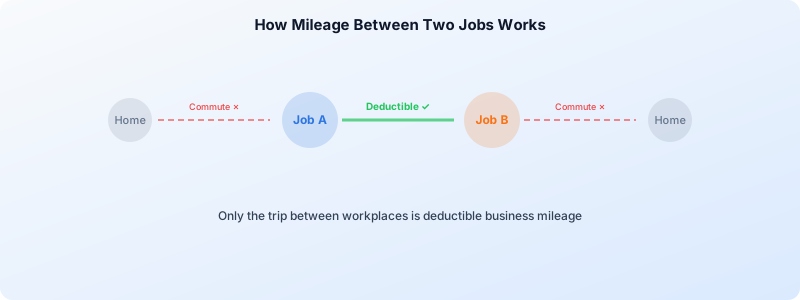
Mileage between two jobs is different. When you leave one workplace and drive directly to a second workplace during the same day, the IRS treats that trip as business travel. This applies whether the two workplaces are for the same employer, different employers, or a mix of employment and self-employment.
The critical distinction: only the travel between the two workplaces counts. Your first trip of the day from home to your first job is commuting. Your last trip from your final job back home is also commuting. Everything in between is where deductible miles can add up.
Who can actually deduct these miles in 2026?
This is where the rules have changed permanently. Before 2018, W-2 employees could deduct unreimbursed business mileage, including miles driven between two jobs, as a miscellaneous itemized deduction on Schedule A. The Tax Cuts and Jobs Act (TCJA) suspended that deduction from 2018 through 2025.
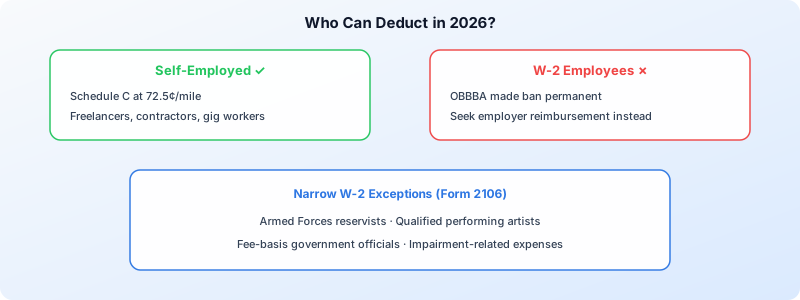
Many taxpayers expected the deduction to return in 2026. It will not. The One Big Beautiful Bill Act (OBBBA) made the elimination of miscellaneous itemized deductions permanent. W-2 employees can no longer deduct mileage between two jobs on their federal tax return, even though the IRS still classifies those miles as business travel.
Who can still claim the deduction:
- Self-employed individuals and independent contractors can deduct mileage between clients, job sites, or any business destinations using Schedule C. The 2026 standard mileage rate is 72.5 cents per mile.
- Armed Forces reservists traveling more than 100 miles from home for reserve duties.
- Qualified performing artists meeting specific income and expense thresholds.
- Fee-basis state or local government officials.
If you are a W-2 employee who does not fall into one of these narrow exceptions, your only option is to request mileage reimbursement from your employer through an accountable plan. Reimbursements under an accountable plan are tax-free to you and deductible for your employer. For more on how this change affects employees, see our guide on business miles vs commuting miles.
Scenarios: which miles count?
Understanding where deductible miles start and stop can be confusing when you have multiple workplaces. Here are the most common situations.
Scenario 1: Two jobs in the same day. You work a morning shift at Job A, then drive to Job B for the afternoon. The drive from home to Job A is commuting (not deductible). The drive from Job A to Job B is business mileage (deductible for eligible taxpayers). The drive from Job B back home is commuting (not deductible).
Scenario 2: Second job on a day off. If you only work at Job B on a given day and drive there directly from home, that trip is commuting. You did not travel between two workplaces, so there is no deductible mileage that day.
Scenario 3: Self-employed visiting multiple clients. A freelance consultant drives from home to Client A, then to Client B, then to Client C, and back home. The first and last legs are commuting. The trips between Client A, Client B, and Client C are all deductible business miles at 72.5 cents per mile.
Scenario 4: Home office changes everything. If you have a qualifying home office that serves as your principal place of business, the IRS treats your home as a work location. That means every trip from home to a job site, client, or second workplace becomes deductible business mileage from the first mile. This is one of the most powerful strategies for people juggling multiple jobs.
The home office advantage for multi-job workers
The home office exception deserves special attention if you work multiple jobs. Without a home office, only the miles between workplaces during the day are deductible. With a qualifying home office, your first trip of the day becomes deductible too, because you are traveling from one work location (your home office) to another.
To qualify, your home office must be used regularly and exclusively for business, and it must be your principal place of business. A dedicated room where you do administrative work, billing, or client communications can meet this standard even if most of your income-producing work happens elsewhere.
For self-employed workers who visit multiple job sites daily, the home office deduction can add hundreds or even thousands of deductible miles per year. If you also travel to temporary work locations, the savings stack even further.
What W-2 employees should do instead
If you are a W-2 employee driving between two jobs, the mileage deduction is no longer available on your personal tax return. But that does not mean you are out of options.
Ask your employer for a mileage reimbursement policy. Under an IRS-compliant accountable plan, your employer can reimburse you at up to 72.5 cents per mile, tax-free. The employer gets a business deduction, and you receive the full reimbursement without it appearing on your W-2.
Track your miles even without the deduction. Employer reimbursement programs require documentation. You need the date, locations, business purpose, and total miles for each trip. A reliable mileage log strengthens your reimbursement request.
Check your state tax rules. Some states still allow unreimbursed employee expense deductions on state returns. California, New York, and several other states did not follow the federal suspension. Your between-jobs mileage might still be deductible at the state level.
Consider whether the home office exception applies to side work. If one of your jobs is freelance or contract-based, you may be able to deduct mileage for that portion of your driving on Schedule C, even if your W-2 mileage is not deductible.
IRS recordkeeping requirements
Whether you are self-employed or seeking employer reimbursement, the IRS requires five elements in every mileage log entry:
- Date of the trip.
- Destination (or route description).
- Business purpose of the trip.
- Total miles driven.
- Odometer readings at the start and end (recommended for audits).
Records must be contemporaneous, meaning you log them at or near the time of travel. Reconstructing a mileage log at tax time from memory is a red flag in an audit and can result in partial or full denial of the deduction.
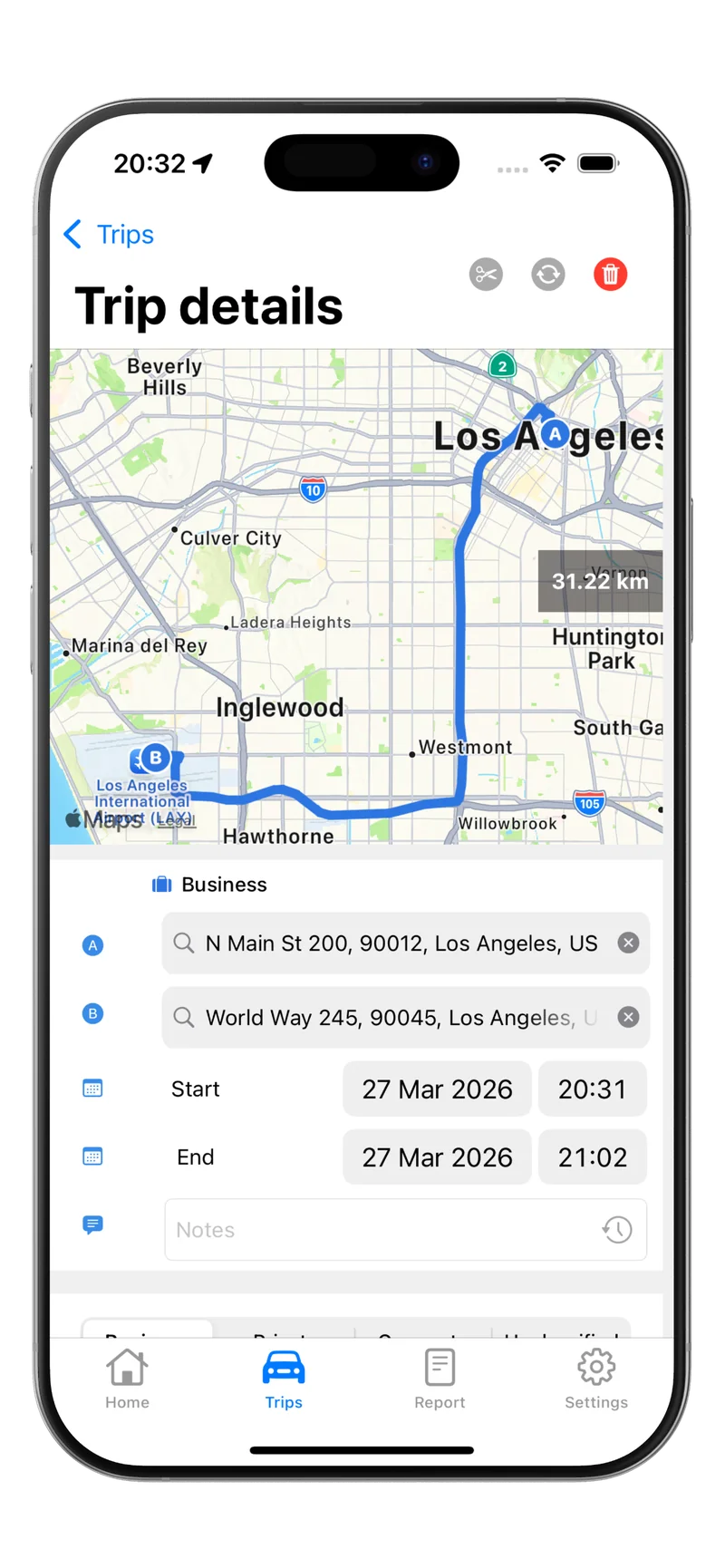
The easiest way to meet these requirements is with an automatic mileage tracking app. Download Tripbook to log every trip between jobs with GPS accuracy, categorize business and personal miles, and generate IRS-ready reports without manual entry.
What you can and cannot stack with the standard rate
When you use the 72.5 cents per mile standard mileage rate, that figure already covers gas, depreciation, insurance, and maintenance. You cannot add those costs on top of the standard rate.
You can, however, still deduct the following separately:
- Parking fees at a business destination.
- Tolls incurred during business travel.
- Loan interest on a vehicle used for business (for self-employed taxpayers).
If your actual vehicle expenses are significantly higher than the standard rate, you may want to compare the actual expense method. But for most people driving between two jobs, the standard rate is simpler and often produces a comparable deduction.
Conclusion
Mileage between two jobs remains classified as business travel by the IRS, but who can claim the deduction has narrowed permanently. Self-employed workers and independent contractors deduct these miles at 72.5 cents per mile on Schedule C. W-2 employees, outside of a few narrow exceptions, must seek reimbursement from their employers instead.
The home office exception is the single most effective way to maximize deductible miles when you work multiple jobs. And regardless of your tax filing status, accurate mileage records are non-negotiable.
Start tracking your between-jobs mileage automatically. Download Tripbook and let the app handle the logging so you can focus on the work.