Cleaning businesses live on the road. Whether you run a residential house-cleaning service, a commercial janitorial company, or a specialized cleaning operation, you and your employees likely drive between multiple job sites every day. Those miles add up fast, and every business mile is a potential tax deduction that reduces your taxable income.
Tracking mileage accurately is one of the simplest ways for cleaning business owners to lower their tax bill, but it requires consistent record-keeping throughout the year.
How the Mileage Deduction Works for Cleaning Businesses
Self-employed cleaning professionals and cleaning business owners can deduct business miles on Schedule C of their federal tax return. The IRS standard mileage rate for 2026 is 72.5 cents per mile.
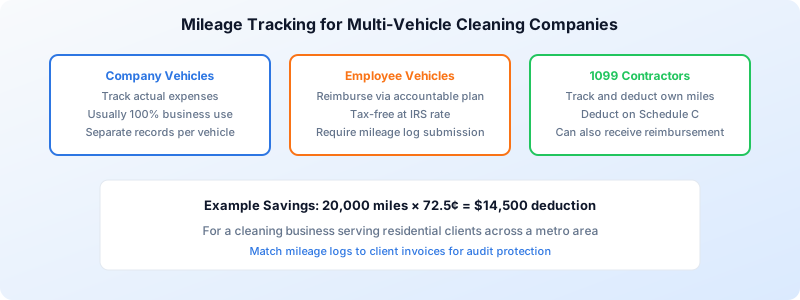
Consider a typical cleaning business that serves residential clients across a metropolitan area. If the owner drives 20,000 business miles per year, the deduction is $14,500. For a small business operating on tight margins, that kind of tax savings is meaningful.
You can also choose the actual expense method, where you track every vehicle cost and multiply by your business-use percentage. The right method depends on your specific situation. Our guide on the standard mileage rate vs actual expenses can help you decide.
Which Miles Are Deductible?
The IRS draws a clear line between business miles and commuting miles. Understanding this distinction is critical for cleaning businesses because the travel patterns can be complex.
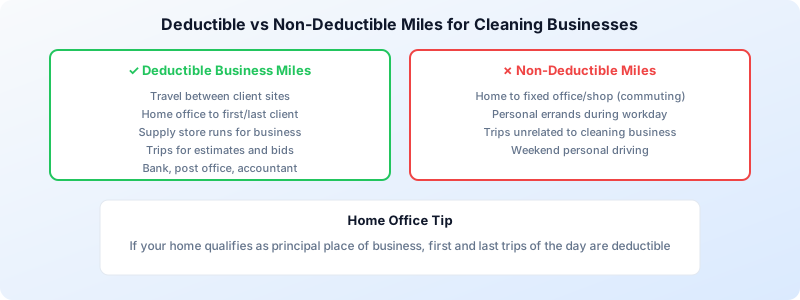
Deductible Business Miles
- Travel from your first client site to your second, third, and subsequent sites during the day
- Trips from your home office to client locations, if your home qualifies as your principal place of business
- Driving to the store to purchase cleaning supplies for your business
- Travel to meet with prospective clients for estimates and bids
- Trips to the bank, post office, or accountant for business purposes
- Driving to pick up or drop off employees at job sites
Non-Deductible Commuting Miles
- Travel from your home to a fixed office or shop, if that is your principal place of business
- Personal errands during the workday that are not related to your cleaning business
The home office rule is particularly important for cleaning businesses. Many cleaning business owners operate from home, using a room for scheduling, invoicing, and storing supplies. If your home qualifies as your principal place of business under IRS rules, the first trip from home to a client site each day is deductible, and the last trip home is also deductible. Without a home office, those trips are considered commuting.
For more on how the home office affects mileage deductions, see our guide on home office mileage deductions.
Tracking Mileage for Employees and Subcontractors
If your cleaning business has employees who drive their own vehicles between job sites, you have two options. You can reimburse them for mileage under an accountable plan, which makes the reimbursement tax-free for the employee and deductible for your business. Or you can pay them a car allowance, which is treated as taxable wages.
The accountable plan approach is better for both parties. It requires employees to submit mileage logs documenting the date, destinations, business purpose, and miles driven. Reimbursement at or below the IRS rate is not taxable and does not appear on the employee’s W-2.
If you use independent contractors (1099 workers), they are responsible for tracking and deducting their own mileage. However, you can still choose to reimburse them for mileage as part of your contract terms. This payment would typically be reported on their 1099 form.
Multiple Vehicles and Fleet Tracking
Many cleaning businesses operate multiple vehicles, either company-owned or a mix of company and personal vehicles. Each vehicle needs its own mileage records, and the deduction method may differ by vehicle.
For company-owned vehicles used exclusively for business, the actual expense method is often straightforward because there is no personal-use calculation. For vehicles that mix personal and business use, you need to track the business-use percentage for each vehicle separately.
If you are deciding between providing company vehicles and having employees drive their own, consider the cost comparison in our article on company car vs mileage reimbursement.
Deducting Other Vehicle-Related Expenses
Beyond mileage, cleaning business owners can deduct several vehicle-related costs depending on the deduction method they choose.
With the standard mileage rate, parking fees and tolls are deductible in addition to the per-mile rate. You cannot deduct fuel, insurance, repairs, or other operating costs separately because the mileage rate covers them.
With the actual expense method, you deduct the business portion of all operating costs: fuel, insurance, maintenance, repairs, tires, registration, loan interest, depreciation, and lease payments. Parking and tolls are deductible on top of these expenses.
Cleaning supply delivery costs, equipment trailer mileage, and other vehicle-related business expenses should also be tracked and deducted.
Record-Keeping Tips for Cleaning Businesses
The IRS requires mileage logs that include four pieces of information for each trip: date, destination, business purpose, and miles driven. For cleaning businesses with multiple daily stops, this can add up to a significant record-keeping burden.
Log each segment separately. When you drive from Client A to Client B and then to Client C, record each segment as its own trip entry. This provides the level of detail the IRS expects.
Match mileage to invoices. Your cleaning schedule and invoices should align with your mileage log. If you billed a client for service on a Tuesday, your mileage log should show a trip to that address on the same day.
Save fuel receipts. Even if you use the standard mileage rate, fuel receipts can help corroborate your mileage claims during an audit.
Simplify Mileage Tracking with Tripbook
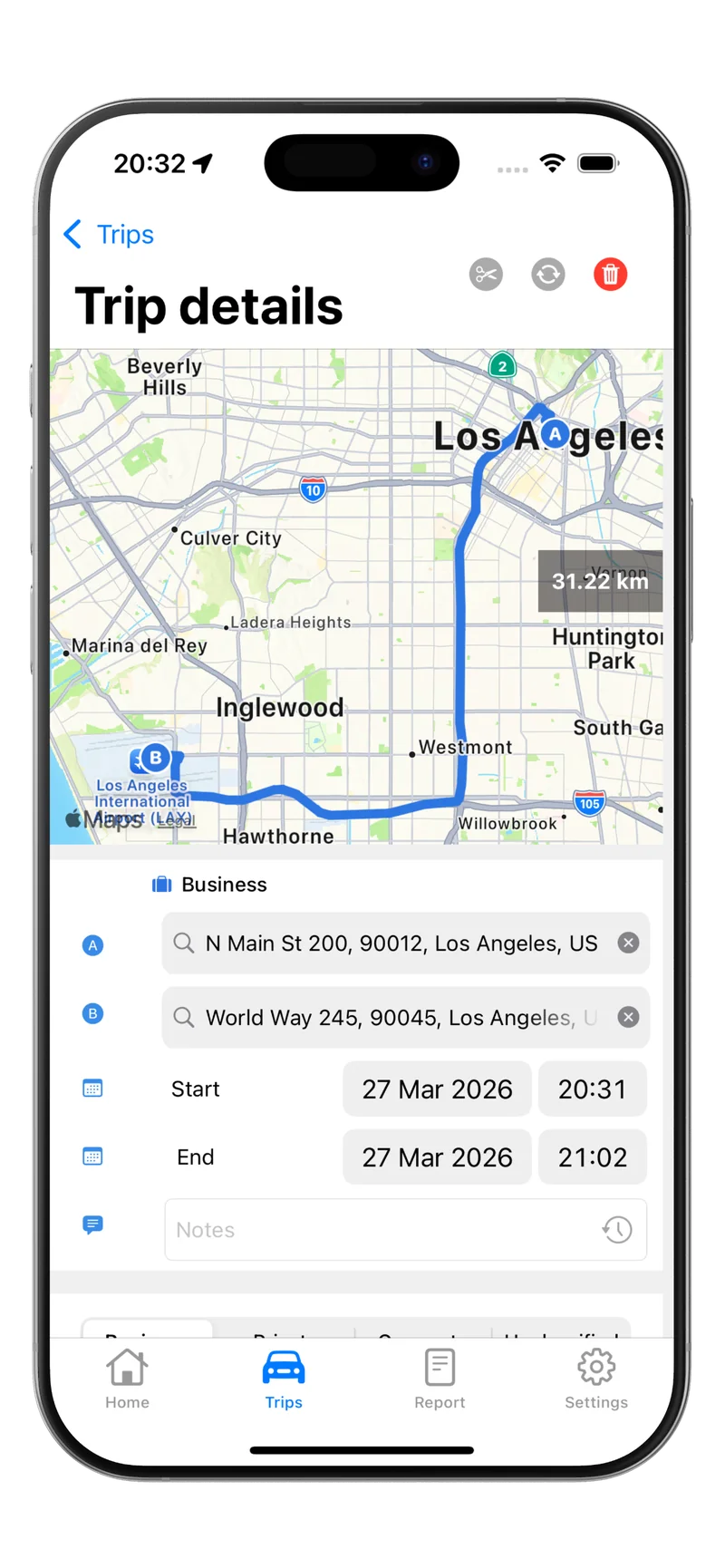
Running a cleaning business means juggling schedules, supplies, employees, and clients. Adding manual mileage tracking to that list creates unnecessary work. Tripbook automatically records every trip with GPS, tracks the route and distance, and lets you classify trips as business or personal. At tax time, you can export a complete IRS-compliant mileage report in seconds, ensuring you capture every deductible mile without the paperwork.