Food truck operators spend a significant part of their business life behind the wheel. Between driving to daily service locations, traveling to events and festivals, making supply runs to wholesale vendors, and visiting the commissary kitchen, the miles pile up quickly. Each of those business miles is a deductible expense that can significantly lower your tax bill if you track them properly.
The mobile nature of the food truck industry makes it uniquely suited for mileage deductions, but the varied travel patterns also make tracking more complex than a typical small business.
How the Mileage Deduction Works for Food Trucks
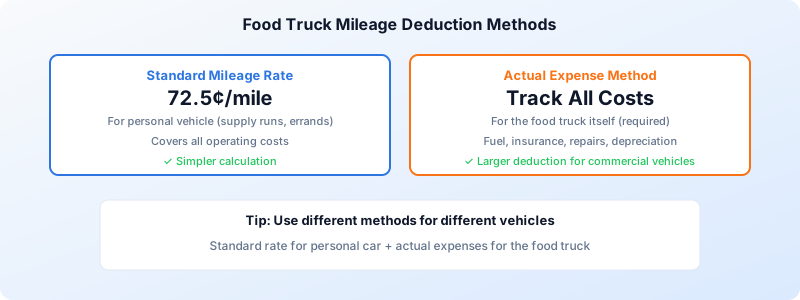
Food truck owners who operate as sole proprietors, LLCs, or partnerships deduct business vehicle expenses on Schedule C. You have two options for calculating the deduction.
Standard mileage rate. For 2026, the IRS rate is 72.5 cents per mile. This covers fuel, maintenance, insurance, depreciation, and all other vehicle operating costs. However, you generally cannot use the standard mileage rate for the food truck itself because the IRS requires that the vehicle qualify as a standard automobile. Most food trucks are classified as specialized equipment, not standard passenger vehicles.
Actual expense method. Track all operating costs for each vehicle and multiply by the business-use percentage. For the food truck itself, this is almost always the right approach because it captures the higher fuel, maintenance, and insurance costs of a commercial vehicle.
For a personal vehicle used in connection with the food truck business (supply runs, scouting locations, bank trips), you can use the standard mileage rate. Many food truck operators use one method for their truck and another for their personal vehicle.
For a detailed comparison, see our guide on the standard mileage rate vs actual expenses.
Types of Deductible Miles for Food Truck Operators
Food truck businesses generate a wide variety of deductible trips. Keeping a clear picture of which travel qualifies is essential for maximizing your deductions.
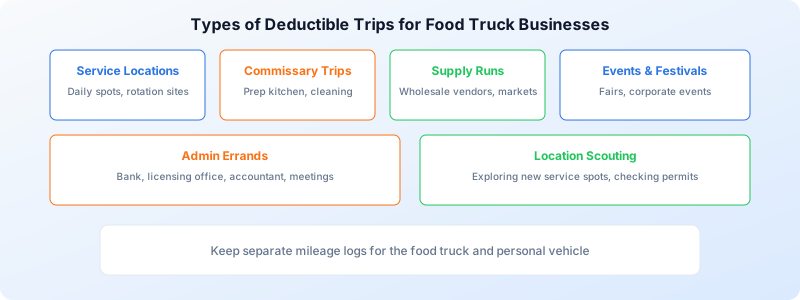
Daily Service Location Travel
Driving your food truck from its parking or storage location to your daily service spot is a business trip. If you rotate locations throughout the week, each trip counts. Travel between multiple service locations during a single day is also fully deductible.
Commissary and Kitchen Trips
Most cities require food trucks to operate out of a licensed commissary kitchen for food prep, cleaning, and waste disposal. Trips between your storage area and the commissary are business miles. If you visit the commissary daily, these trips represent a substantial portion of your annual mileage.
Supply and Vendor Runs
Driving to wholesale food suppliers, restaurant supply stores, farmers markets for ingredients, and other vendors is deductible. These trips often happen multiple times per week and can involve significant distances, especially if you source specialty ingredients from specific suppliers.
Event and Festival Travel
Food truck operators frequently travel to festivals, fairs, corporate events, and special venue locations. These trips, which can be hundreds of miles round trip for regional events, are fully deductible. Keep records of the event name, location, dates, and miles driven.
Administrative and Business Errands
Trips to the bank, the city licensing office, your accountant, or a meeting with a potential event organizer are all business miles. Even short errands add up over the course of a year.
Tracking Miles Across Multiple Vehicles
Many food truck operators use at least two vehicles: the food truck itself and a personal car or pickup truck for supply runs and errands. Each vehicle needs its own mileage records.
For the food truck, track odometer readings at the start and end of each day, along with the destinations and purposes. Because the food truck is used almost exclusively for business, the business-use percentage is typically very high.
For your personal vehicle, track each business trip individually. If you use the vehicle for both personal and business driving, you need to calculate the business-use percentage based on your mileage log.
For information about deducting vehicle expenses as a self-employed business owner, read our guide on vehicle expense deductions for the self-employed.
Other Vehicle-Related Deductions
Beyond mileage, food truck operators can deduct a range of vehicle-related expenses on Schedule C.
Parking fees and permits. Daily parking fees at your service location, event venue parking, and commissary parking are deductible. Many cities charge food trucks a daily or monthly fee for specific locations, and these fees are business expenses.
Tolls. Highway and bridge tolls incurred during business travel are deductible regardless of whether you use the standard mileage rate or actual expenses.
Vehicle insurance. Commercial auto insurance for the food truck is a significant expense and is fully deductible under the actual expense method.
Repairs and maintenance. Engine maintenance, tire replacement, generator servicing, and repairs to the food truck’s serving equipment are deductible. Keep all receipts organized by vehicle.
Record-Keeping Tips
The IRS requires detailed records to support vehicle expense deductions. For food truck operators, this means documenting the date, destination, business purpose, and miles for every trip.
Use a dedicated log for each vehicle. Do not combine food truck mileage with personal vehicle mileage in a single log.
Record odometer readings. Note the odometer reading on January 1 and December 31 of each tax year for every vehicle you use for business.
Keep fuel receipts. Even if you use the standard mileage rate for your personal vehicle, fuel receipts for the food truck are essential for the actual expense method.
Match trips to business records. Your daily sales records, vendor invoices, and event contracts should align with your mileage log entries.
Automate Your Mileage Tracking with Tripbook
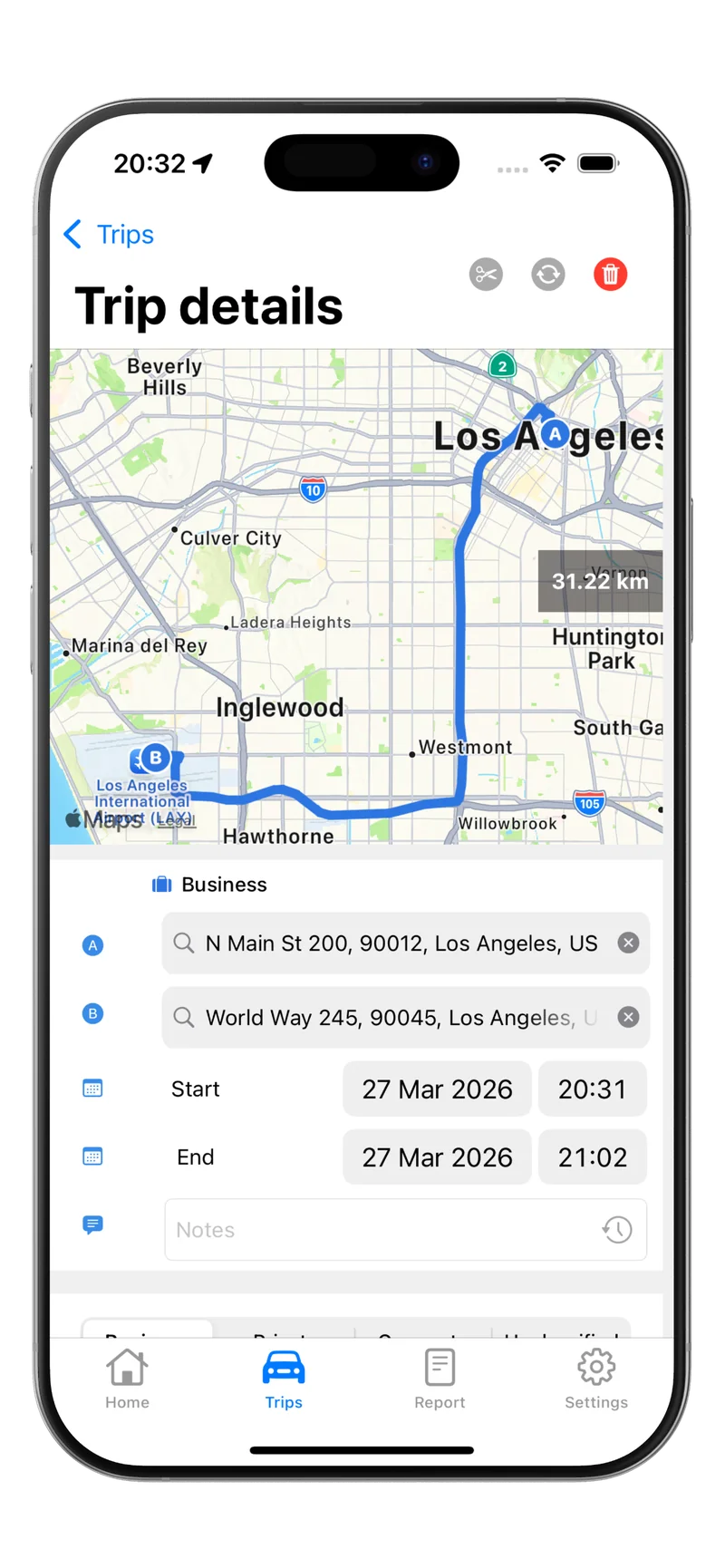
Food truck operators have enough to manage between menus, permits, schedules, and inventory. Manual mileage tracking should not be another burden. Tripbook automatically records trips with GPS, captures the route and distance, and lets you tag each trip with a business purpose. At tax time, generate a complete mileage report that satisfies IRS requirements and ensures you never miss a deductible mile.