Social workers spend a significant portion of their workday behind the wheel. Between home visits, court appearances, agency meetings, and community outreach, the miles pile up quickly. Mileage tracking for social workers is essential whether you are seeking employer reimbursement or claiming tax deductions as a self-employed provider.
A child welfare caseworker might drive 25,000 miles per year visiting families. At the 2026 IRS standard mileage rate of 72.5 cents per mile, that represents $18,125 in potential reimbursements or deductions. Without a reliable tracking system, those miles disappear.
Which Social Work Miles Are Deductible or Reimbursable
Not every mile you drive counts as a business mile. The IRS and most employers follow the same basic rules.
Qualifying business miles include travel from your office to a client’s home for a visit, driving between client locations during the day, trips to court hearings, school meetings, or community resource centers, travel to required trainings and professional conferences, and trips to pick up supplies or deliver resources to clients.
Miles that do not qualify include your regular commute from home to the office and personal errands during the workday.
There is one major exception. If you have a qualifying home office that serves as your principal place of business, every trip from home to a field location becomes a deductible business mile. Many social workers in private practice benefit from this rule.
W-2 Social Workers: Understanding Reimbursement
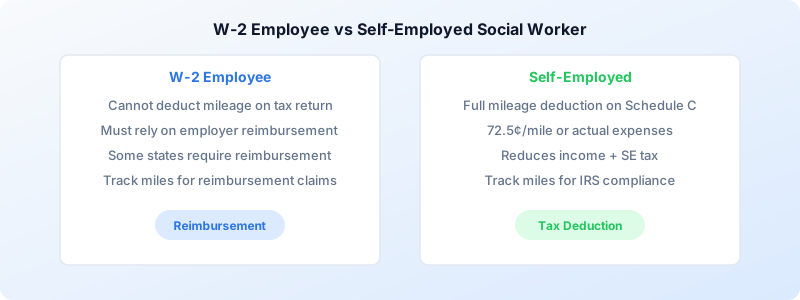
If you work for a government agency, hospital, or nonprofit as a W-2 employee, you cannot deduct unreimbursed mileage on your federal tax return. The Tax Cuts and Jobs Act eliminated that deduction for employees through 2025, and the One Big Beautiful Bill Act signed in 2025 made that change permanent.
However, your employer may offer mileage reimbursement. Many agencies reimburse at or near the IRS rate of 72.5 cents per mile. Some pay a lower rate, and a few provide a flat monthly car allowance.
If your employer reimburses below the IRS rate, you are absorbing the difference out of pocket. For example, an agency paying 50 cents per mile leaves you covering 22.5 cents per mile yourself. Over 20,000 miles, that gap costs you $4,500.
Know your agency’s reimbursement policy. In states like California and Illinois, employers are legally required to reimburse necessary business expenses, including mileage. Check our overview of state mileage reimbursement laws to see what your state requires.
Self-Employed Social Workers: Claiming the Deduction
Licensed clinical social workers, therapists, and private practice providers who are self-employed can deduct business mileage directly on Schedule C. You have two options.
Standard mileage rate. Multiply your business miles by 72.5 cents. At 15,000 business miles, your deduction is $10,875. This method is simpler and covers gas, insurance, maintenance, and depreciation in one rate.
Actual expense method. Track all vehicle costs and calculate the business-use percentage. This method sometimes produces a larger deduction if you drive an expensive vehicle, but requires much more record-keeping.
Most self-employed social workers find the standard mileage rate easier and equally beneficial. You can still deduct parking fees and tolls on top of either method. For a detailed comparison, see our guide on the standard mileage rate vs actual expenses.
How to Build a Mileage Tracking Habit
Consistency is the biggest challenge for social workers tracking mileage. Your days are unpredictable, and logging trips between crisis calls and home visits feels like a low priority.
Here are practical strategies that work.
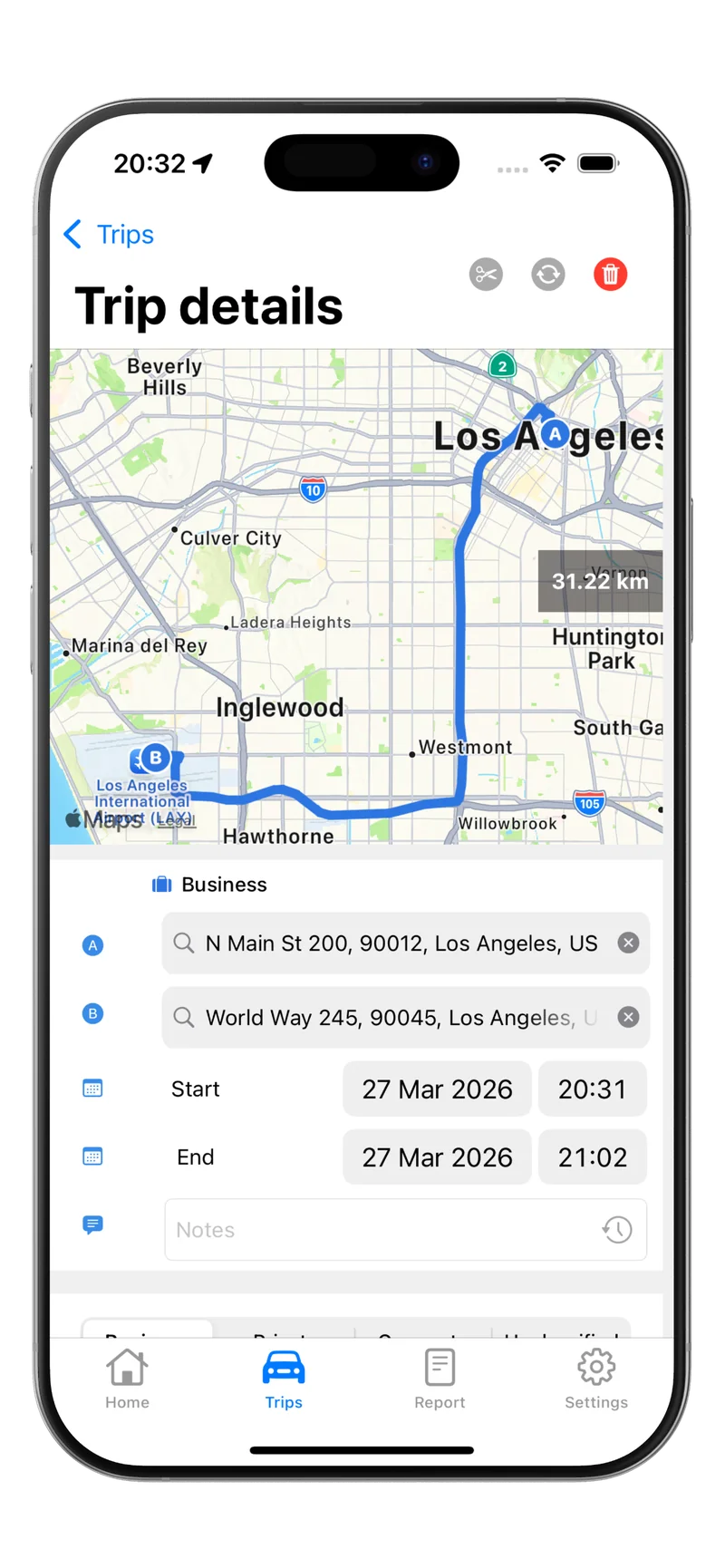
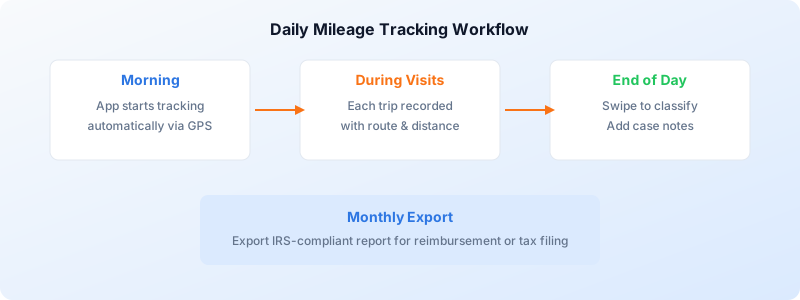
Use automatic tracking. An app like Tripbook detects when you start driving and records the trip automatically using GPS. You do not need to open the app or press any buttons. Between visits, a quick swipe classifies each trip as business or personal.
Classify trips at the end of each day. If you cannot classify in real time, set a daily reminder to review your trips before leaving for the day. Tripbook stores unclassified trips until you are ready.
Add notes for each visit. Jot down the client’s initials or case number as a trip note. This creates the business-purpose documentation the IRS requires without compromising client confidentiality.
Export reports monthly. Do not wait until year-end. Monthly exports keep your records organized and make reimbursement submissions or quarterly tax estimates straightforward.
Handling Mileage for Multi-Stop Days
Social workers often visit four or five locations in a single day. Here is how mileage works on a typical multi-stop route.
Say you leave your office at 8:30 AM and drive to a client’s home (12 miles), then to a second home visit (8 miles), then to court (15 miles), then back to the office (10 miles). Your total business miles for the day are 45 miles, worth $32.63 in deductions or reimbursement.
Over a five-day week with similar routing, that adds up to 225 business miles worth $163.13. In a month, you are looking at roughly $650 to $700.
The key is capturing every segment of the route. Missing even one leg per day means losing over $1,500 per year in potential deductions.
Protecting Client Confidentiality While Tracking
Social workers handle sensitive information. Your mileage log should never contain full client names, addresses, or case details that could identify individuals.
Best practices include using client initials or case numbers as trip notes, storing mileage data locally on your device rather than in a shared cloud, using apps that offer Face ID or password protection, and exporting reports that show mileage totals and general purposes without client specifics.
Tripbook stores all data locally on your iPhone with optional iCloud encryption for backup. Face ID and password protection keep your trip data private, even if your phone is accessed by others.
Make Every Mile Count
Social work demands a lot of driving, and every mile you track translates directly into money saved or reimbursed. Whether you are a W-2 caseworker seeking agency reimbursement or a self-employed clinician claiming deductions, accurate mileage tracking for social workers is a financial necessity. If you are self-employed and juggle multiple roles, check out our guide on mileage tracking with multiple jobs for additional tips.
Download Tripbook and start logging your home visits, court trips, and fieldwork miles automatically.