
If you rent your personal car on Turo, the Turo car rental mileage deduction question comes up fast at tax time. Hosts earn self-employment income, and the IRS expects you to report every dollar on Schedule C. The good news is that vehicle expenses can significantly reduce your taxable profit, but the rules differ from those that apply to rideshare drivers or typical freelancers. This guide explains exactly which deduction method applies, what you can write off, and how to keep records the IRS will accept in 2026.
Why the Standard Mileage Rate Usually Does Not Work for Turo Hosts
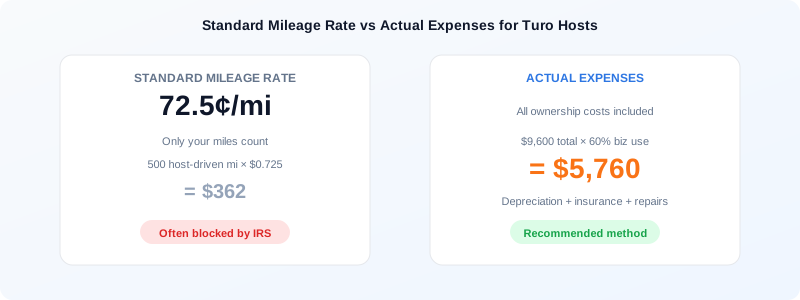
Most self-employed taxpayers choose between two methods when deducting vehicle costs: the standard mileage rate (72.5 cents per mile in 2026) or actual expenses. Rideshare drivers and delivery couriers often prefer the standard rate because they personally drive thousands of business miles each year.
Turo hosting is different. Your guests drive the car, not you. The miles renters put on your vehicle are not miles you drove for business, so the standard mileage rate covers very little of your actual costs. On top of that, the IRS blocks the standard rate entirely when any of these conditions apply:
- You operate five or more vehicles at the same time (fleet rule).
- You previously claimed MACRS depreciation or a Section 179 deduction on the vehicle.
- You use the car “for hire.”
Many Turo hosts with even a small fleet trip the five-vehicle rule, and anyone who claimed accelerated depreciation in a prior year is locked into actual expenses for the life of that vehicle. For a deeper comparison of both approaches, see the full breakdown on standard mileage rate vs. actual expenses.
How the Actual Expenses Method Works for Turo Hosts
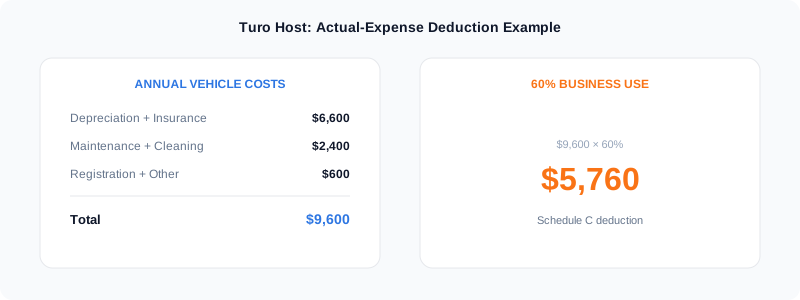
Under the actual expenses method, you add up every cost of owning and operating the vehicle for the year, then multiply the total by the percentage of use attributable to your rental business.
Example: Your car costs $9,600 per year to own and operate (insurance, maintenance, depreciation, registration, fuel, and cleaning). It was rented on Turo for 60% of total miles driven during the year. Your deductible vehicle expense is $9,600 x 0.60 = $5,760.
Expenses You Can Include
- Depreciation — often the single largest line item. MACRS spreads the cost of the vehicle over five years, front-loading the deduction. Section 179 lets you deduct a large portion of the purchase price in year one, subject to annual limits. For vehicles placed in service for Turo, bonus depreciation may also apply; see the vehicle expense deduction guide for the self-employed for current limits.
- Insurance premiums — both your personal auto policy and any supplemental coverage purchased for hosting.
- Maintenance and repairs — oil changes, tires, brakes, and any work needed to keep the car rental-ready.
- Cleaning costs — interior detailing between guest bookings.
- Registration and license fees — the annual cost of keeping the vehicle legally registered.
- Fuel — gasoline or charging costs for the portion of use tied to rentals and business driving.
- Loan interest — the business-use share of interest paid on an auto loan (not the principal).
Your Own Business Driving Still Counts
Even though the standard mileage rate may not apply to your fleet, any miles you personally drive for Turo business purposes — delivering the car to a guest, picking it up, driving to a car wash, or heading to an auto parts store — should still be tracked. Those miles factor into your business-use percentage and increase the share of actual expenses you can deduct. A mileage tracking app makes this effortless.
Reporting Turo Income and Expenses on Schedule C
Turo income is self-employment income. Unlike long-term property rentals reported on Schedule E, the IRS treats car-sharing as an active business because you set prices, approve trips, maintain the vehicle, and coordinate pickups.
On your Schedule C (Form 1040), report the following:
- Gross income — total Turo payouts for the year, including any reimbursement for tolls or fuel. If your gross payments from Turo exceed the 1099-K threshold, you will receive a 1099-K. For 2026, the platform reporting threshold for 1099-K reverts to $20,000 and 200 transactions under the One Big Beautiful Bill Act (OBBBA), which is now permanent law. Even if you fall below that threshold, every dollar is still taxable.
- Car and truck expenses (Line 9) — enter your total deductible vehicle expenses (actual method).
- Other expenses (Line 27a) — Turo platform fees, marketing costs, phone expenses, and any other ordinary and necessary business costs.
- Depreciation (Form 4562) — if you claim MACRS or Section 179 on the vehicle, the amount flows from Form 4562 into Schedule C.
Your net profit (or loss) from Schedule C is subject to both income tax and self-employment tax at 15.3%. You can deduct half of the SE tax on your 1040, and for more detail on how Schedule C works with mileage and vehicle expenses, read the Schedule C mileage deduction guide.
1099 Forms Turo Hosts Should Expect
Turo is a third-party settlement organization, so it issues 1099-K — not 1099-NEC — for rental income paid through the platform. Under the One Big Beautiful Bill Act (OBBBA), the 1099-K reporting threshold permanently reverts to $20,000 and 200 transactions starting in 2026. You would only receive a 1099-NEC from Turo if the company pays you directly for something outside the marketplace, such as a referral bonus. The 1099-NEC threshold is $2,000 (up from $600), indexed for inflation beginning in 2027.
Regardless of whether you receive a 1099, you must report all income. The IRS cross-references platform data, and underreporting is one of the most common audit triggers for gig-economy workers.
Record-Keeping Tips for Turo Hosts
The IRS requires contemporaneous records for vehicle expense deductions. That means logging trips close to the time they happen, not reconstructing a mileage log in April. For each trip, record:
- Date of the trip or rental period.
- Mileage — odometer start and end, or GPS-tracked distance.
- Business purpose — “Turo rental: Guest pickup” or “Vehicle maintenance for fleet.”
Keep receipts for every expense you plan to deduct: insurance statements, repair invoices, cleaning receipts, and Turo fee summaries. Digital copies stored in the cloud are acceptable and far easier to organize than paper.
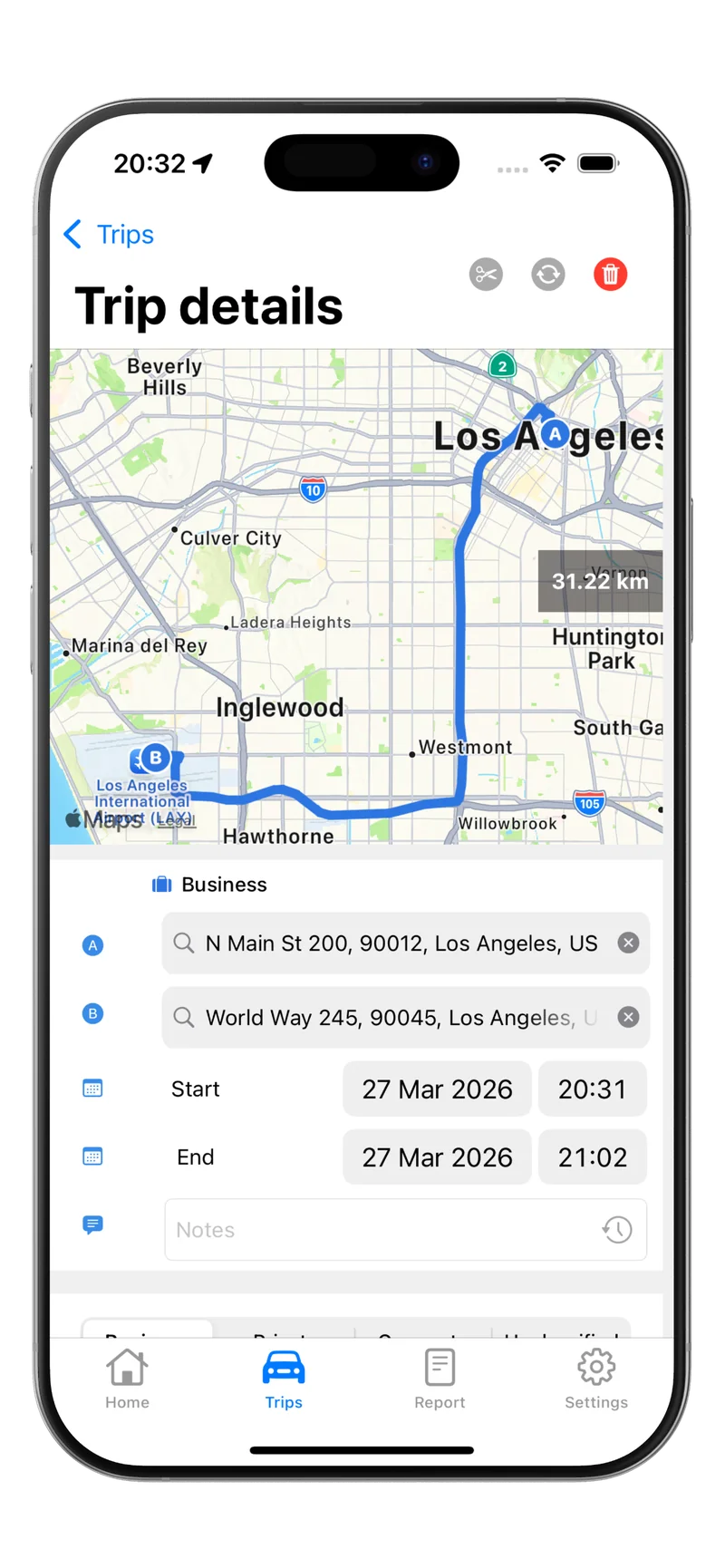
A dedicated mileage tracking app automates the hardest part of compliance. Tripbook logs each drive with GPS, categorizes trips, and generates IRS-ready reports you can hand to your accountant or attach to your return.
Common Mistakes Turo Hosts Make at Tax Time
- Claiming the standard mileage rate for guest-driven miles. The IRS standard rate compensates you for miles you drive. Guest miles belong in the actual expenses calculation instead.
- Forgetting depreciation. Depreciation is a non-cash deduction that can turn a modest cash profit into a paper loss, reducing your tax bill significantly.
- Mixing personal and business expenses. Use a separate bank account and credit card for your Turo business to simplify bookkeeping and strengthen your audit defense.
- Ignoring self-employment tax. Your Schedule C profit is hit with 15.3% SE tax on top of income tax. Quarterly estimated payments help you avoid penalties.
Turo Car Rental Mileage Deduction: Key Takeaways
The Turo car rental mileage deduction is almost always an actual-expenses calculation, not a per-mile rate. Track every cost of ownership, apply your business-use percentage, and claim depreciation to maximize your write-off. Report everything on Schedule C, keep contemporaneous records, and set aside money for self-employment tax.
Accurate mileage tracking is the foundation. Download Tripbook to log every business drive automatically and generate the documentation the IRS requires.